

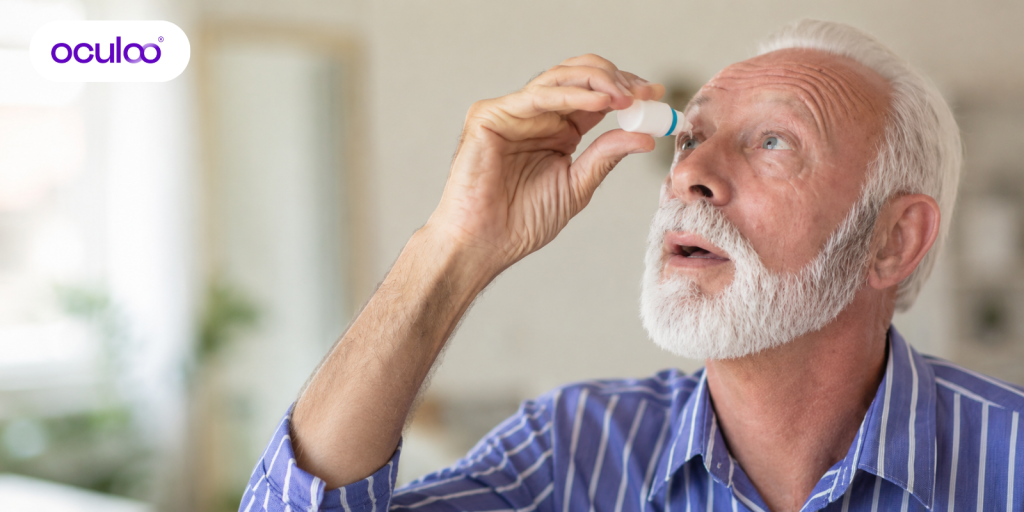
Eye drops missing your eye? Here’s how to prevent it
Eye drops missing your eye? Here’s what you can do
An eye drop seems small and simple to administer. In practice, however, getting the drop exactly into the eye turns out to be quite tricky. The bottle has to be held above the eye, your head tilts back, and all the while you have to keep aiming properly.
As a result, an eye drop sometimes ends up on the cheek, the eyelid or beside the eye.
Does this happen to you often? You are certainly not alone. Problems with aiming an eye drop bottle have been described in research into eye drop technique for years.
Why do eye drops end up beside the eye?
When using eye drops, several movements have to be carried out at the same time.
You have to:
- tilt your head back;
- keep the eye open;
- position the bottle above the eye;
- look upwards;
- hold the bottle still;
- and release exactly one drop at just the right moment.
That sounds simple, but it takes quite some coordination.
Especially when you can barely see the tip of the bottle, judging where the drop will land becomes difficult. The American Academy of Ophthalmology points out, for example, that people with reduced vision can struggle to see the tip of the bottle clearly, which makes aiming harder.
How often does using eye drops go wrong?
Research among people with glaucoma shows that a good drop technique is far from self-evident.
In a study of 85 glaucoma patients, 54.1% had an inadequate eye drop technique. In 11.8% of cases the drop did not reach the eye at all. In addition, the bottle touched the eye, eyelid or eyelashes in some of the participants.
Another study likewise found that eye drops landed on the eyelid or cheek in a considerable group of participants.
So the problem is not only about remembering the medication. The actual act of applying it can be difficult too.
What if the eye drop lands beside the eye?
If the drop lands completely beside the eye, the medication has not reached the eye.
What you should do next may depend on the medicine used. So always follow the instructions from your pharmacy, your doctor and the package leaflet.
Radboudumc, for instance, states that if a prescribed drop lands completely beside the eye, applying another drop may be necessary.
Not sure whether the drop landed correctly? Ask your pharmacist or treating physician what to do with your specific medication.
Why is aiming so difficult?
One key problem is that you look upwards while applying the drop.
That means the bottle partly disappears from your normal field of view. At the same time, the bottle is right above a sensitive body part: the eye.
Many people therefore unconsciously hold the bottle further away, move their hand while applying the drop, or blink as soon as the drop falls.
And that can shift the bottle out of place.
A fixed position can make applying drops easier
When the main difficulty is keeping the bottle in the right spot, an eye drop aid can offer support.
Dutch care organisations also distinguish between problems with aiming, squeezing and stability. The Rotterdam Eye Hospital specifically names eye drop glasses as an aid for people who have trouble aiming and positioning an eye drop bottle or holding their dropping hand still.
How do the Oculoo eye drop glasses help?
The Oculoo eye drop glasses were developed to make one of the hardest parts of using eye drops easier: positioning the bottle.
The eye drop bottle is placed in the glasses. That way you don’t have to position the bottle freehand above your eye.
You put the glasses on, look up and then apply the drop.
So you have to correct the position of the bottle far less yourself while applying the drop.
Applying drops independently starts with control
If eye drops regularly land beside your eye, that does not automatically mean you cannot apply them yourself.
Sometimes the real issue is simply the way the bottle is held and positioned.
An aid that supports this movement can make the daily routine much clearer.
Always use eye medication as prescribed by your doctor or pharmacist. An eye drop aid does not change the prescribed dosage or frequency of your medication.
Source: https://www.oculoo.com/hoe-werkt-het/
Trouble aiming your eye drops?
See how the Oculoo eye drop glasses keep the bottle in a fixed position while you apply your drops.
Related blogs

In more and more regions, home care no longer comes by to administer eye drops: what now?
Home care visits for administering eye drops are becoming rarer. Read why self-administering is becoming more important and how the…

Applying eye drops independently with drop-aid glasses for glaucoma and cataract surgery
Using eye drops seems simple, but many people find it difficult to apply drops accurately, calmly and independently. A drop-aid…